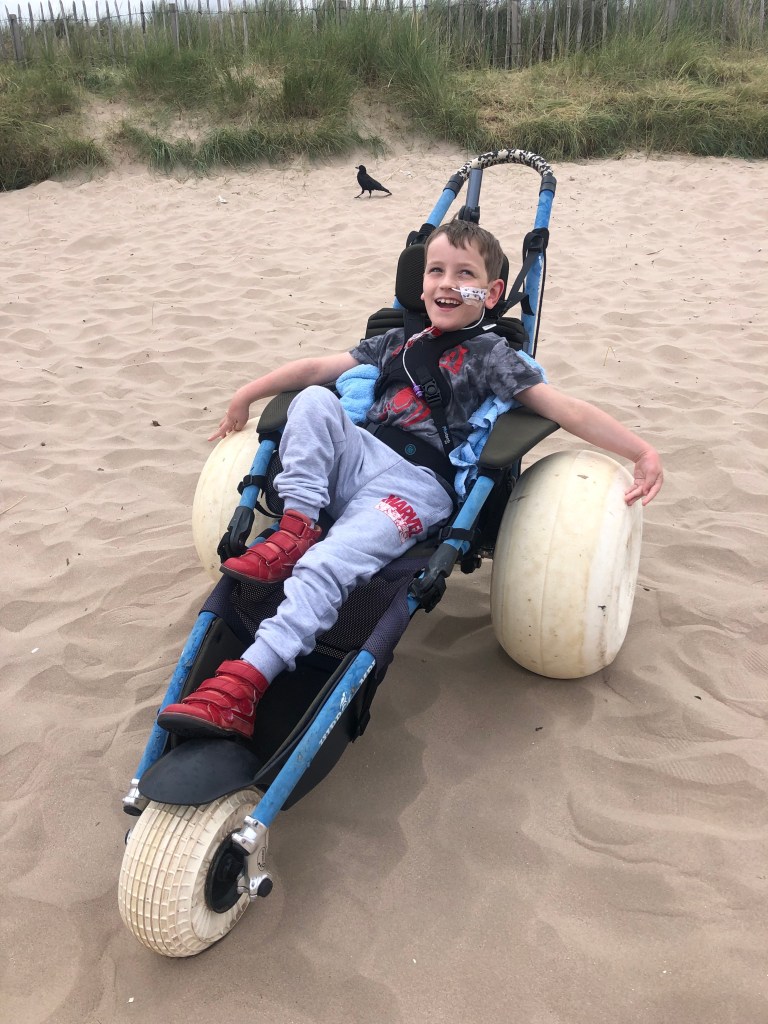
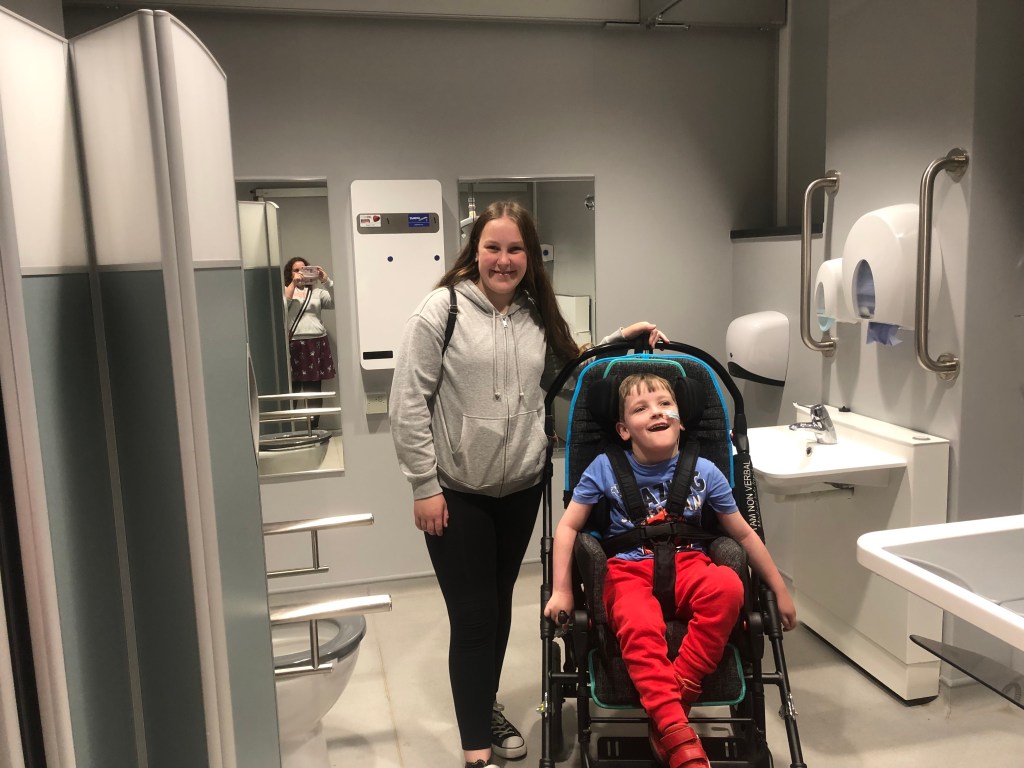
When holidaying on the East Coast of Scotland it is essential to have a beach day for swimming, kite flying or building sandcastles. Having had a great day on the sand in the North of England a couple of years ago thanks to a beach wheelchair we were delighted to see that St Andrews now have them for hire so that we could easily get Quinns onto the sand. The wheelchairs and the newly installed Changing Place toilet adjacent to the beach convinced us that St Andrews was the place for our beach day.
Although we arrived quite late in the day St Andrews Beach wheelchairs were able to provide us with a hippocampe wheelchair for Quinns and off we went onto the sand. Unfortunately, the smallest wheelchair was already being used so the one provided was slightly too big for him.
Despite our ace team working on making him comfortable in the one we had he just wasn’t feeling it. Whether it was size of the chair, the rush to get in or simply that it wasn’t his own custom wheelchair we’ll never know. After a while we decided to abandon the hippocampe and get him out to sit on the sand where he was happy in my arms for the next couple of hours.
Eventually we had to return the hippocampe and get Quinns’ own wheelchair back. Having to use Quinns’ non-beach chair to get him off the beach again made us really appreciate the ease of inclusion the beach wheelchairs provide.
Although it wasn’t Quinns’ day it was amazing to have had the opportunity thanks to St Andrews Beach Wheelchairs. If he had been in a better mood, we would almost certainly have got him down to the sea where his Big Sister spent her entire time swimming.
We will definitely return to St Andrews to try again and also can’t wait to try out the brand new wheelchairs at Nairn beach next summer!
Since it’s a bit tricky getting out and about at the moment we save big trips for special occasions. Our latest day out took us to the Riverside transport Museum in Glasgow. It was possible to spend the entire day there because it had a Changing Places toilet.
Quinns loved seeing the huge selection of vehicles. He pointed out the plane on the ceiling and watched the boats going around for a good long while. A highlight was the lifts that took him to the platforms to see the insides of the trains up close. I’m not entirely sure what he preferred; seeing inside the trains or just being in the lift!
Unfortunately when we tried to access the Tall Ship we were told the lift was out of order. We could have got Quinns onto the upper deck but given the rain we decided to give it a miss. There was plenty inside the museum to see, including a few new rooms we hadn’t seen before.
Today is Rare Disease Awareness day which seems like an appropriate time to share a bit more about the journey we’ve been on with Quinns these last five months.
In September last year Quinns ended up in hospital experiencing a dystonic crisis. Dystonia or involuntary movements are common in Cerebral Palsy. He underwent a whole raft of tests in an attempt to establish the trigger for the crisis. The only way to control the movements, which were by this point causing him physical harm, was to heavily sedate him. With so many sedation drugs on board Quinns eventually needed help to breathe and was put on a ventilator.
The initial cause of the crisis was never established but in the process we discovered that his initial diagnosis was wrong. Rather than Cerebral Palsy, one of the most common childhood disabilities, Quinns actually has a very rare genetic neurodevelopmental condition called GNA01.
GNA01 was only discovered in 2013 and as such there are currently only about two to three hundred people with this particular genetic mutation in the world. It presents in one of two ways either as a movement disorder which looks very like cerebral palsy or as seizures. Sometimes people have both but in Quinns’ case it is simply the movement disorder.
It is obviously a shock to have an entirely new diagnosis after seven years. There’s a lot for us to get our heads around but what does it really change?
Cerebral palsy and the movement disorder caused by GNA01 are very similar. They both result in a disability requiring Quinns to use a wheelchair to get around and an eye gaze computer to communicate. He would have needed all the same equipment and support regardless of the name of the condition. The only thing that really changes is the narrative around his birth. His condition isn’t caused by brain damage but by a change in his genetic coding. There was absolutely nothing we or anyone else could have done when he was born to make his condition any different.
As in Quinns’ case the condition usually presents when a child has an extreme episode of dystonia or hyperkinetic movement which spirals out of control and leads to a long period in intensive care. This is known as a ‘Storm’. If we had known earlier that Quinns had GNA01 and that such a Storm was possible perhaps we could have been more prepared? But on reflection there is very little that I would have done differently for him in the years leading up to the Storm. His life was fun, social and fulfilling and we did everything possible to ensure that for his future.
Although cerebral palsy was the best explanation we were given for Quinns’ difficulties it never fully explained his condition. We now have a condition and a list of symptoms that describe Quinns’ difficulties with movement more exactly. Unfortunately we can’t rule out the possibility of future Storms but hopefully we will be better equipped to avoid them or at the very least deal with them when they arise. Our decisions moving forward can be based on knowing more about the condition we’re dealing with and hopefully more and more research will be carried out on this relatively new discovery.
Although we’ve yet to connect with them, Quinns is now part of a new small community of people with GNA01. There is a tribe of people who present almost exactly the same as him. One thing that struck me when I watched a video about some of the other children with GNA01 was how often their smiles are mentioned.
Quinns has been through a lot these last few months but he’s come out the other side the same smiley happy boy we all know and love. He attracts the attention of many passers by as he sits in his chair atop his hospital bed giggling away while he watches Thunderbirds for the 100th time. Big Sister is of course still his most favourite person.
I set up this blog a short while after Quinns was originally diagnosed with CP. The aim was to share our frustrations and struggles that we faced as a family simply because Quinns was a wheelchair user. Those frustrations and struggles remain the same. Accessibility and societal barriers are still a big problem for him. We still need access to Changing Places toilets to allow him to get out and about and accessible play parks are even more necessary now as he so deserves some fun after all he’s been through.
Hopefully once he gets out of hospital we’ll get back to sharing our life experiences again. In the meantime we want to raise awareness of GNA01 for the two hundred or so people living with the condition as part of the 300 million people living in the Rare Disease Community.
We were lucky enough to manage a week away during the summer holidays. The beautiful Schoolhouse at Fenwick in Northumberland, just a short car journey away from home, provided a brilliant base for our adventures with absolutely everything we needed. I planned our days based on the experiences of a couple of friends so we could relax and enjoy some time away.
Although I am a bit of a planner anyway it does get a little frustrating not to be able to be a bit more spontaneous. Earlier in the holiday I discovered when trying to book tickets for an exhibition on a Saturday evening for the Sunday that I couldn’t get a carers ticket because they were only available to those phoning during working hours Monday to Friday. Another unnecessary obstruction on top of everything else for disabled people who need support.
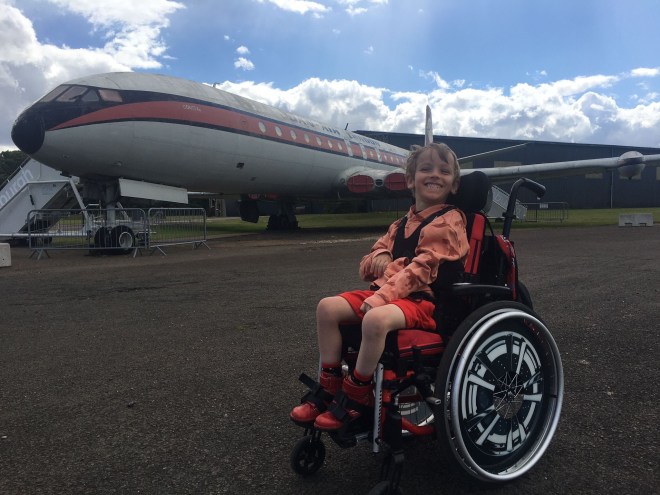
Anyway when we were driving to our holiday I spotted a sign for the National Museum of Flight. A few people had mentioned it to me because of Quinns’ love of planes but I hadn’t done my research nor did I intend to while on holiday. The planning extended to let’s just go on the way home and see what we find. I booked the tickets including a carers ticket online the night before.
As you can imagine for a display that includes aeroplane hangars the site is large. There are disabled parking spaces at each of the buildings and wheelchairs for use by anyone who needs one. As well as large thankfully the site is also very flat and the pathways tarmac which made it easy to get from one building to another so once we were parked up we were ready to explore.
The grounds were full of planes for us to discover. Quinns was immediately very excited to see so many up close. Although we took him on a few flights when he was younger we haven’t quite managed to bring ourselves to again now he’s bigger.
Disappointment came before we even made it to the suggested start of the exhibitions. We couldn’t help but have a closer look at the first plane on route only to realise we could board to see the inside. I stayed with Quinns on the ground while everyone else disappeared up the steps. To be honest I’m not sure he was too bothered about the inside but it wasn’t a good feeling that he was excluded.
At the desk we were given times when each of the planes would be open to explore. Of course I couldn’t help but ask if any were accessible to wheelchair users. A very confused man simply told me no. I was disappointed but not surprised given the difficulties wheelchair users have with flying as described in this recent Guardian article.
Rather than miss out exploring the inside of Concorde with Dad and Big Sister I decided to take copious numbers of photographs to share with Quinns afterwards. Again he was probably more interested in the large screens showing videos of the red arrows in action or Concorde in flight but I couldn’t help wondering why there isn’t more effort to make at least one interior available for wheelchair users who might be interested?
After lunch we went to explore the Fantastic Flight hangar. I was seriously impressed. There were loads of interactive exhibits for children and adults to explore and learn about flight. Quinns was absolutely fascinated by the balloon that filled with air and rose up. Even better, it was operated by a button that he could reach and press himself! He also spent quite a lot of time trying out the controls for operating different parts of the plane. Although he had a good go at all the different levers his favourite was the one that switched the lights on. For someone who often has to sit passively at such places this was amazing!
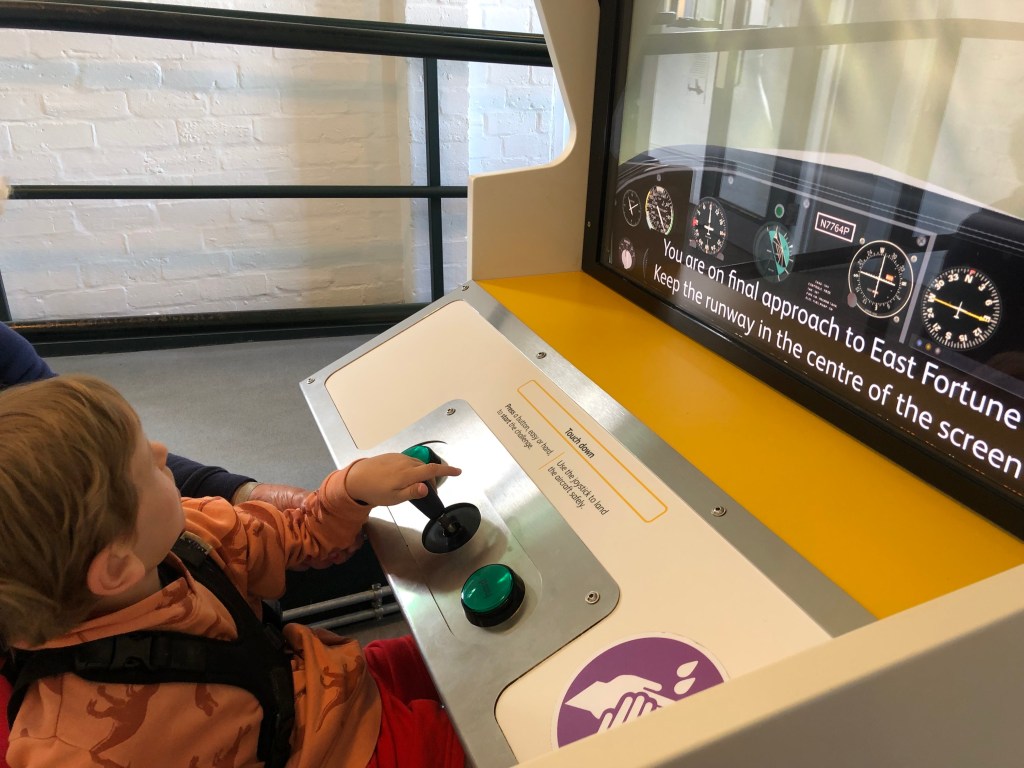
He was also able to have a good go at the flight simulator but given that his favourite activity was letting the plane crash I think I might leave it a while before he starts flying lessons!
So our little bit of spontaneity paid off on this occasion. The museum redeemed itself from the immediate disappointment of inaccessibility with interactive installations that Quinns could actually enjoy. However there are no excuses on a site that large not to have a Changing Places toilet which would have made our day even better!
As everyone now comes to terms with being in lock down our family have been shielding for well over a week. Quinns’ respiratory issues make it too risky for him to be around others. My asthma means I too am classed as vulnerable and as his primary carer I can’t take any chances.
When Quinns was first diagnosed our world shrunk. There were barriers, both social and physical that closed in on us as many people and places became inaccessible to him. I’ve spent considerable time pushing back against those barriers trying to widen the scope for him (and others).
Now as the Covid-19 pandemic strikes that same thing has happened again. Only this time it’s more extreme and everyone is in it together. You no longer have access to the people and places you had before and that is not easy.
While homeschooling Quinns & Big Sister last week I was finishing off an online course (I’ve given up attempting to do any work of my own!) about Inclusive Education. Now as the schools close and everyone stays home in exclusive bubbles, the entire situation is almost exactly the opposite of inclusion.
Our discussions about schooling for Quinns revolve around balancing his learning with socialisation. We want Quinns to go to the same school as his friends because we rank peer relationships pretty highly. How many of our children are going to miss their friends because they are being home schooled and no longer able to participate in extracurricular activities?
I appreciate we all have considerable worries at the moment. We must pull together to get through it but during lock down I hope people will have a chance to reflect and learn from this experience what a lot of disabled people already know, the importance of access and socialisation.
We are very fortunate to be locked down in our ‘new’ house with amazing garden. It’s ideally set up for Quinns to access everything he needs including chats with family & friends online and of course he’s fully included in our little quartet. We plan to make the most of our time. Getting round to all the activities we never have time for normally all the while trying not to let the worry take over.